
The Complete Guide to Off-Grid Living: Solar Power, Security Cameras, Lighting, and Property Protection
Building an off-grid property is the process of creating a homestead, cabin, or workshop that can operate entirely without relying on public utilities like electricity, internet, or municipal water lines. However, a truly successful off-grid setup is not just about power generation. It is about creating a complete, self-sustaining environment where energy production, perimeter security, and physical infrastructure work together as a unified system.
Most failed off-grid installations happen for one specific reason: systems are built in isolation. Property owners often size their solar arrays without considering security draw, install surveillance systems without calculating winter energy drops, or add high-output exterior lighting without understanding battery storage limits.
A resilient off-grid property treats everything as one connected ecosystem. This comprehensive authority guide breaks down how to engineer your power foundation, visibility layers, surveillance networks, and physical defenses to build an uncompromised, fully autonomous property.
Quick Answers About Off-Grid Living
What is off-grid living?
Off-grid living means generating and storing your own electricity and managing your own essential utilities so your property can operate independently from public utility companies.
Can a cabin run fully on solar power?
Yes, a cabin can run fully on solar power. A properly sized solar panel system paired with a dedicated lithium battery bank can reliably power lighting, household appliances, water pumps, and security systems year-round.
What is the best battery for off-grid systems?
The best battery for off-grid systems is a LiFePO4 (Lithium Iron Phosphate) battery. LiFePO4 batteries are the industry standard because they last 10 times longer, handle deep discharge cycles down to 0% without damage, charge faster, and require zero maintenance compared to older lead-acid batteries.
Can security cameras run on solar power?
Yes, security cameras can easily run on solar power. Most modern security cameras use very low wattage and can run continuously 24/7/365 on a small, dedicated solar panel and battery backup setup.
Do security cameras need internet to work?
No, security cameras do not need internet to work. Off-grid security cameras can record footage completely offline using local storage methods like internal SD cards or on-site Network Video Recorder (NVR) systems. Alternatively, they can use cellular networks for remote alerts without needing local Wi-Fi.
Do solar lights work in winter?
Yes, solar lights work in winter. Modern solar panels are highly sensitive and can harvest energy even on cloudy or overcast days. However, total overnight runtime will depend on your local winter sunlight hours and the size of your battery reserve.
The Costly Reality of Off-Grid Design: Real Mistakes
Before you start, read: How to Calculate Your Off-Grid Power Needs Step-by-Step (With Worksheet). Having this data ready prevents the common mistake of undersizing your system, which leads to hardware failures.
Before buying a single piece of hardware, there is one non-negotiable rule that determines whether your property succeeds or fails: Your power system must be designed before everything else.
Security cameras, outdoor lighting, and tools do not define your setup; your daily energy budget defines everything. If you purchase perimeter equipment before calculating your exact power load, you will run into severe system bottlenecks. Troubleshooting detached workshops and remote property builds reveals that almost every catastrophic system failure comes down to the exact same oversight.
The "Cheap Inverter" Trap: A Real-World Lesson
Early on when building out remote equipment structures, a classic mistake was made on a project. A workshop system was sized perfectly on paper for a continuous running load of 800 watts (including LED lights, a router, and a couple of cameras). To save a few bucks, a cheap 1,000-watt modified sine wave inverter was brought in. The very second a standard high-end power tool was plugged in to begin an interior building project, the entire system went black instantly.
The mistake was forgetting about surge and inductive loads. Any device utilizing an electric motor or compressor (such as heavy power tools, air compressors, or compact refrigerators) draws up to three to four times its normal running wattage just to turn over. That cheap inverter didn't just safety-trip; the sudden voltage spike fried a $400 network router sharing the circuit. Do not guess your surge requirements. Buy a high-quality, pure sine wave inverter rated for peak surge, and save yourself an emergency midnight trip to a dark property.
- Accelerated Battery Drain: Continuous low-voltage draws from unmonitored security gear will pull your storage down faster than your solar panels can recover.
- System-Wide Shutdowns: Inverters will fault out if a device's starting surge exceeds the system's peak capacity.
- Unreliable Security Coverage: Cameras and critical alarms will drop offline during extended periods of overcast weather if your battery bank lacks proper isolation.
Solar Power System (Core Foundation)
Solar power is the backend engine of your entire off-grid ecosystem. It determines how long your lights run, how reliable your surveillance stays, and whether your property can survive a multi-day storm. When you are housing expensive assets, tools, or high-end firearms in an industrial-grade safe inside a detached building, your security loop cannot have a single point of failure.
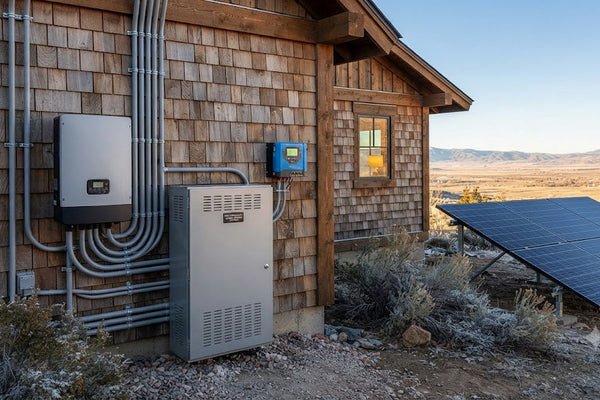
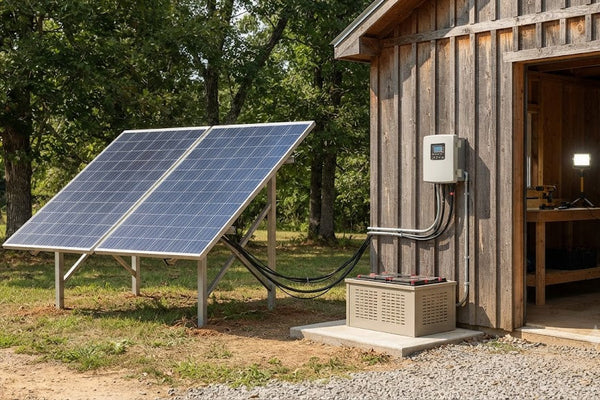
Every balanced off-grid installation relies on four primary components:
- Solar Panels & Arrays: Capture sunlight and convert it into direct current (DC) electricity. View Solar Panels & Arrays Collection
- Charge Controllers: Regulate the incoming voltage and current from the panels to safely charge the battery bank. Always use MPPT (Maximum Power Point Tracking) over PWM—PWM controllers waste up to 30% of your array's potential in cold weather.
- Inverters: Convert stored DC battery power into alternating current (AC) electricity required by standard household tools, charging blocks, and appliances.
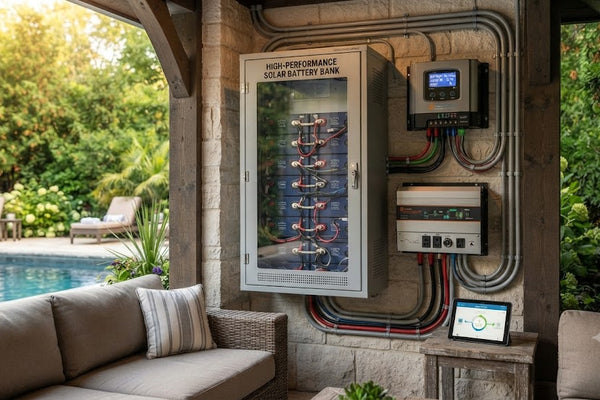
- Lithium Battery Storage: The central energy reservoir that saves your generated power for overnight and bad-weather use.
How Off-Grid Solar Sizing Actually Works
To size your system accurately, you must calculate your total daily energy consumption in watt-hours (Wh).
Step 1: List Your Daily Electrical Loads
Identify every device that will draw power from your central system. For a standard remote hunting cabin or off-grid workshop, your baseline infrastructure might look like this:
- Continuous security cameras (24/7 draw)
- Perimeter LED lights (Nighttime visibility)
- A compact, high-efficiency refrigerator or tool charging bay
- A cellular or Wi-Fi router (Constant data transmission)
Step 2: Calculate Daily Consumption
Multiply the active running wattage of each device by the exact number of hours it operates per day.
| Off-Grid Load Component | Device Wattage | Hours Active Per Day | Total Daily Usage (Wh) |
|---|---|---|---|
| Off-Grid Security Cameras (x2) | 10W | 24 Hours | 240 Wh |
| Exterior LED Security Lighting | 30W | 5 Hours | 150 Wh |
| Cellular / Wi-Fi Router | 15W | 24 Hours | 360 Wh |
| Device Charging / Small Electronics | 50W | 4 Hours | 200 Wh |
| Total Daily Energy Baseline: | 950 Wh | ||
Step 3: Integrate Regional Winter Solar Logic (The "Sun Hours" Reality)
If your system is losing power despite normal usage, read: Why Is My Off-Grid Solar System Draining Batteries So Fast in the Winter? This guide identifies the specific culprits—like excessive low-voltage draws or under-sized storage—that often go unnoticed until temperatures drop.
This is where standard online solar calculators fail you. They use "yearly averages" for sunlight. If you size a Midwestern or Northern workshop based on a yearly average of 4.5 peak sun hours, your security system will go dead by mid-December. You must design for the worst-case seasonal scenario (Winter Solstice).
The Regional Peak Sun Hours Formula
To find out how many solar panels you actually need to keep your batteries charged in the dead of winter, use this equation:(Total Daily Baseline Wh × 1.3 Safety Buffer) ÷ Regional Winter Peak Sun Hours = Required Panel Wattage
Let's look at how our 950 Wh baseline load changes drastically depending on where your property or workshop kit is physically located:
| Region / Climate Example | Winter Peak Sun Hours | The Math (950Wh × 1.3 Buffer) | Minimum Array Size Needed |
|---|---|---|---|
| Sunbelt States (Arizona, Texas, Florida) | 4.0 Hours | 1,235 Wh ÷ 4.0 | 308 Watts (approx. 3x 100W panels) |
| Midwest / Mid-Atlantic (Indiana, Ohio, Pennsylvania) | 2.0 Hours | 1,235 Wh ÷ 2.0 | 617 Watts (approx. 3x 200W panels) |
| Northern / Snowbelt (Upstate NY, Michigan, Maine) | 1.5 Hours | 1,235 Wh ÷ 1.5 | 823 Watts (approx. 4x 200W panels) |
The Takeaway: If you build a detached garage or remote hunting cabin in a northern climate, you need nearly triple the physical solar panel space as someone building the exact same setup in the South just to run the exact same security cameras in December. If you don't account for this regional drop, your system will slowly degrade, starve your battery cells, and shut down your security perimeter when you need it most.
Battery Storage: Sizing for Cold-Weather Autonomy
If solar panels act as your generator, your battery bank is your fuel tank. To keep an off-grid property running reliably, you must build your system around the Principle of Autonomy—meaning your battery bank should hold enough reserve power to run your property for 3 full days with zero sunlight or if snow completely covers your panels.
The Battery Killer: Freezing Temperatures
Another real-world warning: Traditional lead-acid batteries lose up to 50% of their usable capacity when temperatures drop below freezing. If you store them in an uninsulated backyard shed kit or outdoor box, a 400Ah bank effectively turns into a 200Ah bank during a freeze.
This is why we exclusively recommend LiFePO4 Lithium Batteries. While they cannot be safely charged below freezing without internal thermal heating blankets, they retain their output efficiency far better and handle deep discharges down to 0% without permanent capacity degradation.
- Small Cabins / Outbuildings: 200Ah to 400Ah battery bank
- Medium Workshops / Garages: 400Ah to 800Ah battery bank
- Full-Time Off-Grid Homes: 800Ah to 2,000Ah+ battery bank
If you want to bypass the trial-and-error of individual component matching, read: How to Power a Remote Workshop or Shed with a Complete Solar Kit. Investing in pre-engineered kits guarantees that your panels, controllers, wiring gauges, and inverters are perfectly balanced for maximum safety and efficiency right out of the box.
If you want to bypass the trial-and-error of individual component matching, investing in pre-engineered Shed & Outbuilding Solar Kits guarantees that your panels, controllers, wiring gauges, and inverters are perfectly balanced for maximum safety and efficiency right out of the box.
For those looking to safeguard a primary cabin or establish emergency readiness, utilizing complete Whole-Home Backup Kits ensures your vital systems stay online during grid blackouts or multi-day blizzards.
Similarly, if your property development involves portable assets, incorporating RV & Mobile Charging Stations provides an adaptable power infrastructure that travels with you without drawing from your stationary buildings.
Solar Security Lighting (Off-Grid Visibility System)
Outdoor lighting is your most immediate and cost-effective physical crime deterrent. It actively discourages trespassing, eliminates blind spots where intruders hide, and vastly improves the video clarity of your surveillance cameras. A dark property invites inspection; a clean, brightly lit perimeter signals active, professional monitoring.
Engineering Your Visibility Layer
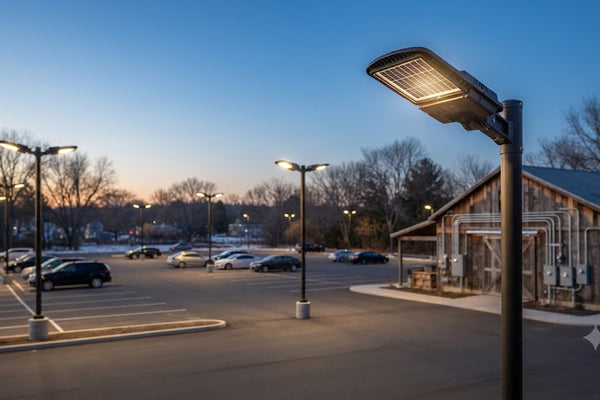
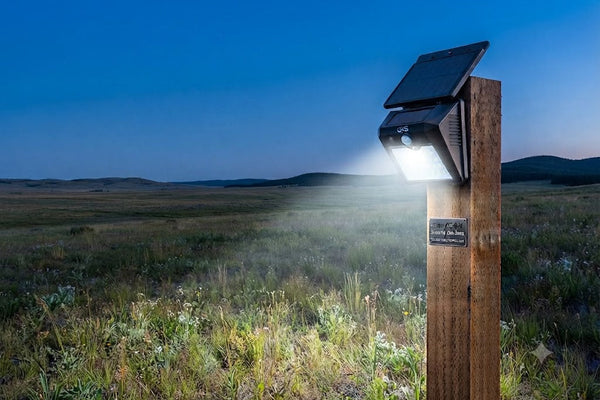
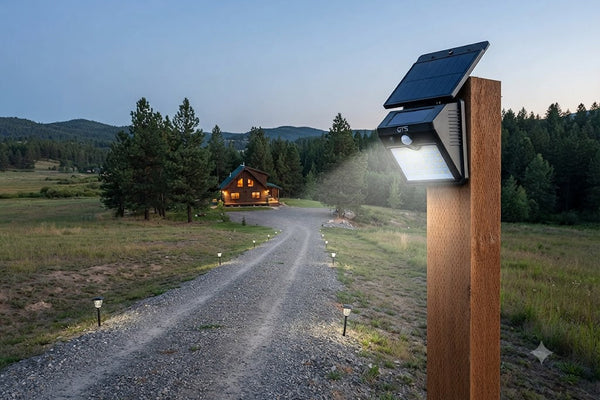
Modern off-grid properties use self-contained Solar Security & Lighting solutions fixtures that feature their own dedicated solar cells and internal lithium cells. This intentional system separation is critical: it ensures that your overnight security lighting never pulls energy away from your primary cabin battery bank or triggers a system-wide power failure.
Motion Sensor vs. Dusk-to-Dawn Engineering
These lighting types are not interchangeable. They serve completely distinct structural defense roles and must be deployed strategically to conserve energy.
Motion-Sensor Lighting (The Deterrent Layer)
- Best Locations: Entrance doors, window lines, tool sheds, blind corners, and equipment bays.
- How it Works: The light remains completely off or in an ultra-low dim state until an onboard Passive Infrared (PIR) sensor detects heat and movement, instantly switching to 100% blinding brightness.
- Strategic Advantage: Minimal power draw, maximum battery conservation, and an excellent psychological shock effect that startles intruders and immediately alerts surrounding cameras.
To maximize your coverage area without wasting energy, read: Where Should You Place Security Lights on a Rural Property for Maximum Protection?. This article explains the geometry of motion sensors and how to position fixtures to eliminate blind spots and deter trespassers.
Dusk-to-Dawn Lighting (The Navigation & Area Layer)
- Best Locations: Main driveways, property gates, main walking pathways, and active outdoor work zones.
- How it Works: Built-in photocells automatically switch the fixture on at sunset and off at sunrise.
- Strategic Advantage: Provides constant, predictable visibility and uniform illumination across transit zones, but requires significantly larger solar panels and battery cells to sustain an all-night continuous draw.
If your lighting performance is fading, read: How to Fix Dim Outdoor Solar Lights During Freezing Months. This guide covers common battery-voltage issues and panel cleaning techniques that restore full brightness to your security perimeter.
If you are looking for the most budget-conscious way to deter trespassers, read: The Cheapest Way to Secure a Remote Rural Property Using Solar Lighting. This guide covers how to strategically place high-impact, low-cost solar fixtures to create the perception of a fully monitored, professional security perimeter.
[Outer Perimeter: Dusk-to-Dawn Gate Lights] → [Transit Zones: Path Lights] → [Structure: Motion-Sensor Floodlights]
High-Priority Placement Strategy
Do not position lights based on aesthetics. Place them based on human access behavior and vulnerability zones:
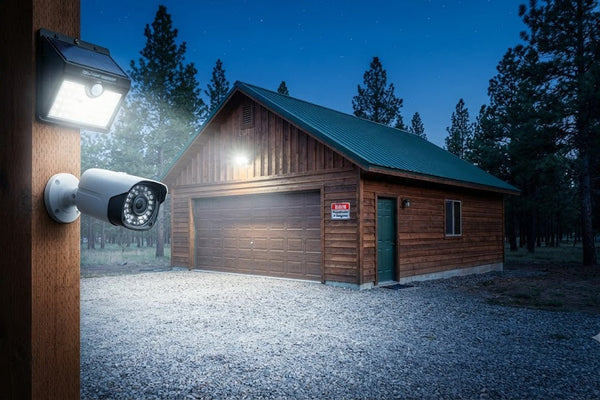
- Primary Entry Points: Mount dual-head motion floodlights directly above front, back, and side doors, as well as over overhead garage or workshop bay doors.
- High-Value Assets: Focus high-output floodlights directly on fuel storage tanks, generator cages, vehicle parking tracks, and tool outbuildings.
- Blind Zones & Approach Paths: Position lights along building corners, structural transitions, and near tree lines that approach your main buildings. Ensure that your lighting footprints overlap slightly to completely eliminate unlit gaps where an intruder could advance unseen.
Off-Grid Security Camera Systems
Key Terminology
- LiFePO4: Lithium Iron Phosphate; the safest, longest-lasting battery chemistry for off-grid power.
- MPPT: Maximum Power Point Tracking; a controller that maximizes solar panel efficiency.
- Pure Sine Wave: The high-quality AC power required to safely run sensitive electronics like NVRs and cameras.
- Autonomy: The number of days your system can run without sunlight before the battery is depleted.
Security cameras represent the critical detection and evidence layer of your off-grid defense. While lighting reveals a presence, surveillance confirms the exact activity and provides real-time alerts.
Power Sizing for Security Infrastructure
To maintain a continuous, uncompromised surveillance loop, you must select the right camera architecture based on power efficiency:
| Camera System Type | Average Power Consumption | Primary Power Strategy |
|---|---|---|
| Trail Cameras | Under 1 Watt | Completely autonomous; runs months on internal lithium AA cells. |
| Battery-Powered Cameras | 1W to 3W | Self-contained; recharges via an attached 5W–10W solar panel. |
| Wi-Fi Smart Cameras | 3W to 8W | Requires constant 12V DC power from a central battery box. |
| Cellular Cameras | 5W to 10W | Requires continuous power for internal 4G/5G LTE modems. |
| Hardwired NVR Cameras | 5W to 15W per camera | Powered via Power-over-Ethernet (PoE) from a central recorder. |
If you notice your surveillance loop failing after dark, read: Why Do Off-Grid Security Cameras Stop Working at Night? (And How to Fix It). This guide explains the power-draining effect of night-vision IR LEDs and helps you optimize your battery and camera settings to ensure 24/7 reliability.
The Separation Rule for Surveillance Power
Critical Infrastructure Rule: Never wire your security cameras into your primary household power circuits without a dedicated, isolated breaker loop. If a high-draw appliance like a water pump or power tool trips your cabin's main inverter overnight, your entire security network will drop offline instantly. Keep your surveillance lines separated or run them on standalone, dedicated solar setups.
Choosing Your Off-Grid Storage Architecture
If you need to maintain privacy or operate in a location with no signal, read: Can You Run Security Cameras Without Internet or WiFi? Off-Grid Storage Explained. This article covers how to configure NVRs and SD-card setups to ensure you have reliable surveillance without needing a constant internet connection.
Where and how your video is saved dictates how independent your system will be from local cellular or internet infrastructure.
1. Local SD Card Storage
Footage is written directly onto industrial-grade microSD cards inside each camera body.
- Pros: Requires zero internet or Wi-Fi network; ultra-low setup cost; highly energy efficient.
- Cons: No remote access or live viewing; if an intruder steals or smashes the camera, the evidence is lost.
2. Local NVR (Network Video Recorder) Systems
Cameras stream video back via local ethernet cables or a closed Wi-Fi router to a central, hardened recording hub hidden inside your secure structure.
- Pros: Massive storage capacity (terabytes of footage); supports multiple cameras simultaneously; operates 100% offline without any internet connection.
- Cons: Higher hardware installation complexity; requires steady continuous power to keep the central NVR drive running.
3. Cellular Security Cameras
Cameras utilize an internal cellular modem to upload motion-triggered clips directly to cloud servers and send push notifications to your smartphone.
- Pros: Instant, real-time alerts from miles away; live video monitoring; secure off-site cloud backup.
- Cons: Requires a steady local cellular signal; involves monthly data subscription fees; consumes more power during video transmission.
Camera Installation & Deterrence Strategy
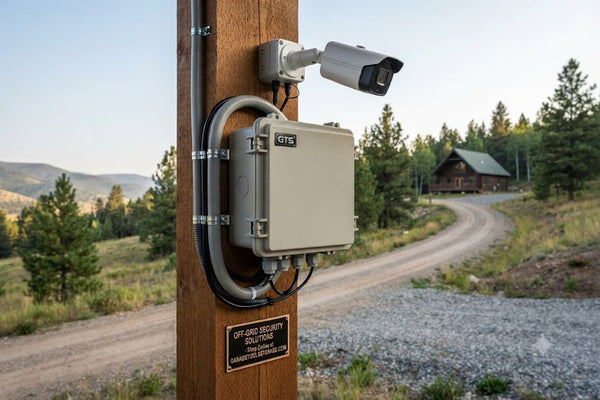
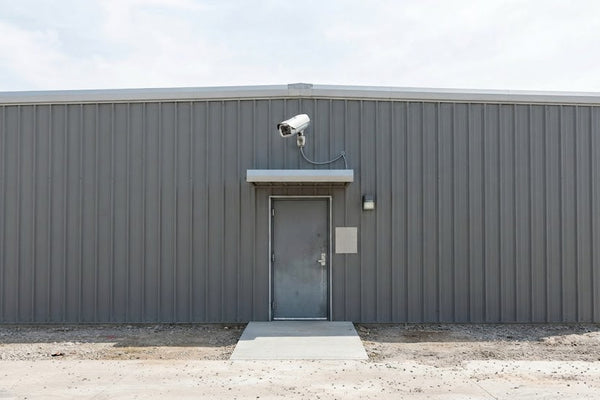
In off-grid and rural security, visible cameras outperform hidden ones. Mount prominent, commercial-grade bullet or dome cameras at a height of 9 to 10 feet. This keeps them out of reach of easy tampering while sending an explicit message to opportunistic thieves that the property is heavily defended.
For the ultimate security layout, use a layered approach: place highly visible perimeter cameras to act as your primary psychological deterrent, and hide a few rugged trail cameras near tree lines or entrance bottlenecks to capture clear backup evidence if someone attempts to blind or vandalize your visible security systems.
Physical Security & Asset Protection
Solar panels, perimeter lighting, and security cameras only detect, record, or discourage problems—they cannot physically stop an intruder. Physical security is the final barrier that determines whether your valuables are protected if a thief breaches your outer lines.
In remote, rural environments, property losses rarely stem from sophisticated, high-tech break-ins. They happen because of easy, fast opportunities: weak door frames, unlocked outbuildings, visible high-value tools, and completely exposed generators. Your goal is time resistance—every extra minute it takes to breach a lock or door frame increases the likelihood that a thief gives up and abandons the attempt.
[Layer 1: Perimeter Control] → [Layer 2: Detection] → [Layer 3: Structural Hardening] → [Layer 4: Asset Safes]
The 4-Layer Defense Architecture
Layer 1: Property Perimeter Control (The Boundary)
Your first line of defense is your property line. Stop vehicle access and create an immediate psychological threshold using heavy iron driveway gates, robust perimeter fencing, and clear "Private Property: Video Surveillance" signage.
Layer 2: Detection Layer (The Warning)
This layer alerts you and captures footage before anyone touches your structures. It includes your motion-activated floodlights, cellular cameras, and long-range driveway alarms which serve as an excellent low-power early warning system along access trails.
Layer 3: Structural Security (The Hardened Shell)
This is where you physically resist forced entry. Replace hollow-core exterior doors with solid wood or metal-clad doors. Upgrade to heavy-duty deadbolts, reinforce your wooden door frames with heavy steel strike plates, and install 3-inch hardened screws into all hinges so the door cannot be simply kicked or pried open. For remote cabins and workshops, protect vulnerable windows with shatterproof security film or interior steel security bars.
Layer 4: Asset Protection (The Final Line)
The core layer designed to protect your highest-value assets even if your outer structural shells are fully breached. This means locking your power tools inside heavy steel job site boxes, anchoring high-end gear to concrete slabs, and storing firearms, titles, deeds, and critical property documentation inside an industrial-grade, pry-resistant MESA Safe.
If you need a step-by-step breakdown for securing your workshop, read: How to Build a Layered Security System to Protect Tools in a Detached Garage. This guide provides specific techniques for hardening entry points and organizing tools to make them unattractive targets for opportunistic thieves.
View MESA Safes & Heavy Duty Storage Options
Targeted Asset Hardening Strategies
- Hunting Cabin Hardening: Because hunting cabins sit empty for weeks or months at a time, they are prime targets for tool, fuel, and firearm theft. Never leave hunting gear or firearms loosely stored or visible through windows. Secure all firearms and expensive optics inside a fireproof, anchored safe.
- Off-Grid Workshop & Garage Protection: Workshops hold your highest-resale items: power tools, welding gear, and construction hardware. Reduce visibility by frosting or blocking out workshop windows so thieves cannot catalog your tools from the outside. Inside the shop, organize your tools inside lockable, heavy-gauge steel cabinets and stamp or engrave your driver’s license number or business name onto your valuable tools to make them instantly harder for a thief to resell.
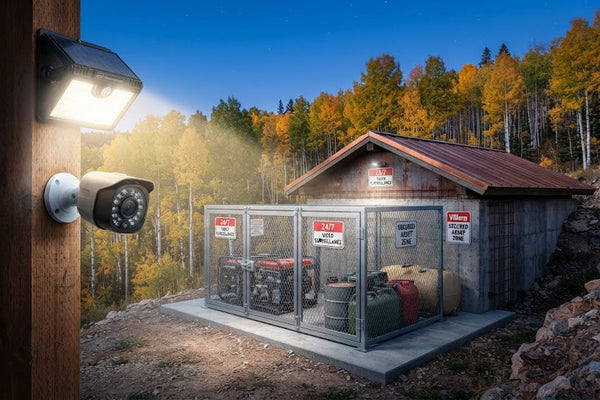
- Fuel & Generator Security: Fuel and portable generators are liquid gold in rural areas and are the most frequently stolen off-grid assets. Never leave a standalone generator sitting loose on a porch or in an open yard. Chain your generator to a heavy concrete ground anchor or secure it inside a dedicated, ventilated steel cage. For fuel tanks, implement heavy-duty locking caps, surround the tanks with motion-sensor lighting, and ensure they sit directly in the clear line of sight of your surveillance cameras.
If your off-grid setup relies on backup power, read: How to Secure an Off-Grid Generator and Fuel Storage on Remote Property. This guide covers how to physically anchor your generators, lock down fuel reserves, and configure security lighting specifically for these high-theft assets.
Expert Implementation Checklist
Follow this exact phase-by-phase roadmap to build out your off-grid property systematically, ensuring you never overtax your budget or your energy systems.
Phase 1: Establish the Power Foundation
- Calculate your total expected daily energy draw in watt-hours (Wh).
- Install a scalable Shed & Outbuilding Solar Kit or a high-capacity Whole-Home Backup Kit.
- Deploy your LiFePO4 Lithium Batteries in a secure, insulated, and temperature-sheltered environment.
- Validate power stability by running the system under full load for 48 hours before adding any peripheral systems.
Phase 2: Deploy Perimeter Visibility & Surveillance
- Install standalone solar motion-sensor floodlights at all primary structural doors, gates, and windows.
- Mount visible, low-draw security cameras 9 to 10 feet high on building corners to eliminate blind spots.
- Configure your offline NVR storage hub or set up cellular cloud links for real-time mobile alerts.
- Place high-visibility surveillance and trespassing warning signs at your driveway gate and main perimeters.
Phase 3: Harden Physical Infrastructure & Assets
- Reinforce all exterior wooden door frames with heavy steel strike plates and 3-inch hardened screws.
- Install commercial-grade deadbolts and secure workshop windows with shatterproof security film.
- Secure portable assets like ATVs and generators using heavy chains, ground anchors, or locking cages.
- Secure your firearms, ammunition, deeds, and high-value tools inside an anchored, heavy-duty MESA Safe.
Advanced Off-Grid FAQ & Troubleshooting
Why do off-grid solar systems fail during winter?
Off-grid solar systems typically struggle in winter due to a combination of significantly shorter sunlight hours, heavy snow accumulation covering the panel faces, and increased energy draw from staying indoors longer. To prevent winter failures, always tilt your panels at a steeper angle to shed snow naturally and oversize your solar array by 20% to 40% beyond your summer power needs.
What should I do if my off-grid system keeps dying overnight?
This is a textbook symptom of an undersized battery bank or an uncalculated phantom load drain. First, disconnect all non-essential devices overnight to identify hidden power draws. If the system still drops voltage rapidly, you must increase your battery storage capacity (Ah) before adding any more devices or expanding your panels.
Why do my security cameras stop recording intermittently?
This issue is usually caused by full or corrupted local storage media, or a momentary drop in power stability. Ensure you are using specialized "high-endurance" surveillance SD cards rated for continuous rewriting. If running a cellular security camera, checking your local signal stability is key—a weak cell signal forces the internal modem to draw double its normal power trying to connect, which can trigger automatic low-voltage shutdowns.
How many solar panels are required just to run security cameras?
For a standalone, isolated security setup, a single low-draw camera typically requires only a 50W to 100W solar panel paired with a small 50Ah to 100Ah lithium battery. For a comprehensive, multi-camera hardwired NVR surveillance network, you will generally need a dedicated 200W to 400W solar panel array to guarantee continuous 24/7/365 recording through poor weather.
Can I expand my off-grid lithium battery bank later as my needs grow?
Yes, but you must follow proper battery matching practices. One of the greatest benefits of modern LiFePO4 lithium battery storage systems is their modular expansion capability. However, when adding new batteries in parallel to an existing bank, ensure they are of the exact same chemical type, voltage rating, and ideally from the same manufacturer to maintain even power distribution and prevent premature cell aging.
Final System Integration Summary
A genuinely resilient, bulletproof off-grid property relies on the seamless integration of four foundational layers:
| Structural Layer | Core Components Included | Primary System Objective |
|---|---|---|
| 1. Power Foundation | Solar Panels, MPPT Controllers, Pure Sine Inverters, LiFePO4 Battery Banks | Generates and stores the operational energy budget for all structural loads. |
| 2. Visibility Network | Self-contained Motion Spotlights, Dusk-to-Dawn Pathway Lights, Photocells | Eliminates blind spots, startles physical intruders, and optimizes camera vision. |
| 3. Surveillance System | Cellular Cameras, Local SD Media, Closed NVR Hubs, Real-Time Mobile Feeds | Identifies structural threats, records visual history, and transmits remote notifications. |
| 4. Physical Armor | Reinforced Deadbolts, Steel Cages, Strike Plates, Ground Anchors, MESA Safes | Physically resists forced entry attempts and provides localized asset security. |
When these four systems are designed and deployed together as a single, comprehensive plan, you create a property that is energy independent, continuously monitored, physically hardened, and fully capable of protecting your high-value assets for decades to come.
Next Steps for Your Off-Grid Build
You now have the technical blueprint for powering and securing your remote property. To begin your installation, explore our curated Solar Outbuilding Kits and Heavy-Duty Security Storage to protect your hardware from the elements and opportunistic theft.
Explore the Knowledge Center
More guides from the Knowledge Center
Ready to power your property off-grid?
Jump straight to the solar category you need - complete off-grid systems, panels and arrays, security lighting or solar cameras.


