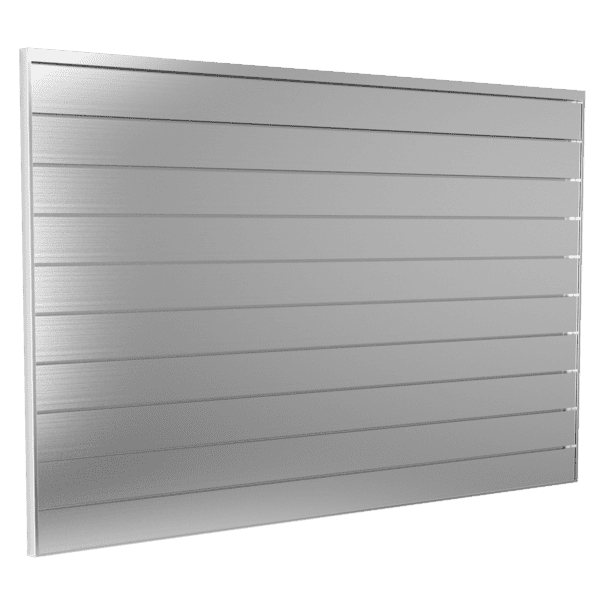


Proslat Aluminium Slatwall Panels
Proslat
- Regular price
- Price: $309.99
- Regular price
- List Price: $629.99
- Sale price
- Price: $309.99
- Unit price
- per
Couldn't load pickup availability
Share
 PRODUCT DESCRIPTION
Proslat aluminium slatwall is the metal panel in the Proslat range. It uses the same groove profile as the PVC and PROCORE panels, so the same hooks, baskets and shelves fit, but the panel itself is aluminium rather than plastic. It suits a wall that takes knocks from machinery, a commercial bay or a shop, and a garage where you want a metal look rather than a painted one.
Choosing a panel size
There is one finish, so the only decision here is size, and it is a handling decision as much as a coverage one. The 8 ft x 4 ft panel covers a run of wall with fewer seams and fewer levelling checks, and a long wall done in 8 ft panels looks cleaner because there are fewer joins to line up. It is awkward to carry and hold in place on your own, and aluminium dents if you lever it against a corner while you are wrestling it into position. The 4 ft x 4 ft panel is easy to handle single-handed, fits a short wall, an alcove or the gap between a door and a corner without cutting, and is the easier one to take up a step ladder.
How much do I need?
The 8 ft x 4 ft panel covers 32 sq ft and the 4 ft x 4 ft panel covers 16 sq ft. Measure the wall width and multiply it by the height you actually want covered. The useful band is roughly waist height to just above your reach, about 4 to 6 ft, not floor to ceiling. Subtract windows, the man door and the strip the garage door track runs through. Add about 10 percent for cuts and offcuts you cannot reuse, then divide by 32 or 16 to get the panel count. These are sold as single panels, so order the number you need; for comparison, three 8 ft panels give you 96 sq ft and four give you 128 sq ft.
Installation
Screws must reach the studs behind the wall, not just the drywall. Find and mark the studs before you start, because drywall anchors alone will pull out once a panel is loaded. Get the first row level and check it with a long level or a laser line before you drive the second screw — every panel above follows that first line, and a small error at the bottom shows as a slope by the time you reach the top. Panels go over existing drywall, straight onto bare studs, or onto block and concrete with masonry fasteners and furring strips so the screws have something to bite into. Cut aluminium with a fine-tooth blade, wear eye protection, and file the cut edge before you handle it.
Common questions
How much weight will it hold?
The limit is the fixings and the framing behind the panel, not the aluminium. Screwed into sound studs at the recommended spacing it carries more than most garage walls ever see. Miss the studs and the wall gives way long before the panel does.
Will it rust or rot?
No. Aluminium does not rust and does not absorb water, so a damp, unheated garage or a hosed-out bay is not a problem. It will not warp with heat the way a plastic panel can on a wall that gets direct sun.
Can I mix this with another Proslat line?
Yes. The groove profile is shared, so hooks, baskets and shelves move between the aluminium, PVC, PROCORE and PROCORE+ panels, and you can run aluminium on the working bay and PVC elsewhere.
What is the difference between this and the PVC panels?
PVC is lighter, cheaper and comes in four colours; aluminium is more rigid, will not warp in heat, and gives a metal finish. Both are waterproof and both take the same accessories.
Can I paint it?
Painting aluminium needs an etch primer and it rarely stays looking good in a garage, so treat the finish as the finish. Use trim if you want the edges and seams tidied.
Not sure how much you need? Send your wall width and height to info@garagetoolsstorage.com or text (888) 949-4945 — a photo of the wall helps — and we will work out the panel count and trim list. Prefer to call? Leave a message on (888) 949-4945 and we will reply by email or text.
Related: all slatwall panels · trim & finishing · bundles & kits · bins, baskets & shelves
Great reasons to buy from us: